30. Port St. John’s to Shark Point (Mpande)
7 - 11 March 2024


IMAGES
30. Port St. John’s to Shark Point (Mpande)
7 - 11 March 2024
to know
to really know
The time had come for me to start at the finish line and start making my way back towards finding myself wherever I might yet find myself as I continued to walk towards the end. The next four days are going to put a serious dent in the outstanding sections and after completing the next four days, I will know that the finish line is moving towards me - as I make my way towards it. it has only ever been this - like inevitability. like knowing.
Departing from Port Elizabeth (PE) at 10:00 AM we met up with Leon Hechter at his home in Cove Rock, East London, at 12:30 PM to collect my walking stick, which I had forgotten in his vehicle during my last hike in the Transkei. After a quick toasted sandwich and cool drink, I hit the road again and arrived in Port St Johns (PSJ) at 18:00. I was hungry and thirsty as I hadn't stopped in the busy Mthatha due to traffic and high crime levels. I stopped at "Steve's Pub and Restaurant" for a large pizza and a beer. They recommended Amapondo Backpackers for accommodation, so I drove to 2nd Beach in Port St. John’s, easily finding the bright entrance sign and gate. Even though I didn’t have a reservation and it was almost 20:00, the friendly staff made me feel welcome. I had a clean room with a shower, basin, toilet, and even a TV, while my car was safely parked in a locked area.
Some places remain unchanged, not because time is gentle, but because they have learned to endure.
THURSDAY, 7 March 2024 - Cape Hermes Lighthouse to Umngazi River Hotel
Woke up at 05:00, filled my rucksack’s water bladder, re-packed my clothes, and left the gate by 06:00. At 2nd Beach car park, I looked back at the sun rising behind "The Gap," a special place full of memories. I then started the first uphill climb of the day, a 1.5 km road leading to Silaka Nature Reserve. A friendly lady guard was surprised I was hiking alone but assured me the path was well-maintained, though hilly. I continued to the cottages, where I had my first rest at the closed reception office. For the first time, I had signal and could speak to Cathy, letting her know where I was. I opened my first Powerade and took a photo before heading down to the beach below. There wasn’t much of a beach, but after crossing a shallow stream, I faced the hour-long climb up "Heartbreak Hill." I rested many times, finding shade when possible as the heat and humidity really took their toll, and I was drenched in sweat.
By 09:00, I reached the top, where there was a bench and refuse bins. I rested for about 30 minutes, drinking lots of water. A young German couple caught up with me, and we descended the steep hill towards Sugar Loaf, passing through dense forest. I was too slow, and they went ahead. At the beach, I took pictures of "Sugar Loaf," then missed the footpath leading up the hill. A missed turn is only ever a new journey. I rounded the point along a grass edge and found myself scrambling up uneven rocks. I climbed through a mudslide area and faced a steep hill that really tested me. I could only manage 20 steps at a time, taking over an hour to reach the top, with no shade from the harsh sun.
At 11:00, I finally reached the top and collapsed on the ground with my rucksack under my head, drinking water to recover. At 11:45, I got up, took a photo of "Sugar Loaf" far below, and continued walking along the ridge with breathtaking sea views. The path was easier now, with only small ups and downs, but the heat drained me. I stopped for another rest at 13:00 and lay down for about 30 minutes, worried I might be in a tick-infested area. I was soaked in sweat and used a small towel under my cap to keep cool. I met the German couple again as they made their return journey to PSJ, and the lady offered me a bottle of water. They were concerned about my slow pace but assured me the path ahead was easier. I continued, and the path indeed cleared up with more beautiful scenery. Eventually, I reached the last corner and saw the river below and the endless beach leading towards Mngazana.
Completely drained, I descended the hill towards the road leading to Umngazi Resort. I had to be cautious with every step. By 13:30, I reached the gate, where a friendly guard offered me his chair. I had no reservation again, so the guard had to call reception to let me in. After paying for the overnight stay, I had a shower and took a nap on the double bed until 17:30. I then had a beer and supper, served from 19:00. I went straight to bed after supper, my legs still sore.
Survival is not a moment — it is a conversation between body and land.
FRIDAY, 8 March 2024 - Umngazi River Hotel to Umgazana River Mouth
I had restless sleep, waking up several times. I boiled water to fill my water bladder and cool down. My legs felt much better as I walked down the steps to breakfast, enjoying a full meal and taking some fruit for "padkos." At 08:00, I crossed the wide river in a motorboat on a calm day. I nearly fell when my foot caught on the side of the boat, but another passenger helped me. The "Imana Cycle" sign reading, "Out there alone, racing the tide, food for the soul… paradise pedaled," marked the start of a long stretch of open beach. The tide was low, and I felt comfortable as my legs had recovered more than expected.
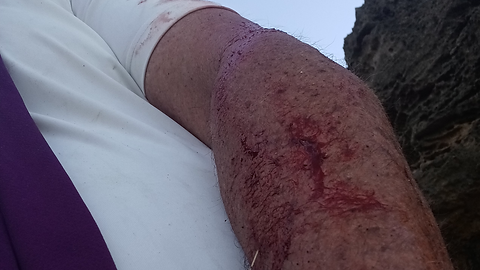
Up ahead, I could see a rocky landscape, and I knew I had to reach it while the water was still low. At 08:40, I scrambled up between narrow rocks, cutting my left shin on a sharp edge. Then, I found myself on a dangerous, narrow ledge about 5-10 meters above the wet beach. Unable to turn back, I decided to throw my rucksack, cap, and walking stick over the edge. Slowly, I crawled along the ledge, holding onto every rock, root, or plant to cover about 50 meters. At the end was a sheer drop of about 3 meters. I grabbed onto a tree branch, lowered myself carefully, and dropped onto some small rocks below. I was bleeding from both arms and legs, but nothing felt broken.
I walked back to the sea to collect my rucksack and walking stick, washed myself with sea water, and ate a bruised banana and naartjie that survived the fall. After taking some time to recover, I continued, and soon the beach stretched for about 3 km until I reached the Mngazana river mouth, which was filling up with the rising tide. Despite being told a ferry would be there, no one was in sight. Just as I was about to swim across, a young man with a paddle ski appeared and ferried me across. I paid him R20, and he was so grateful he walked me to a spaza shop, where we both bought 2 liters of Lemon Twist.
By 10:30, I had decided my day had been dramatic enough, and I needed to get back to PSJ to collect my car. Locals directed me to a tavern on a steep hill, and by 11:00, I was inside with about 10 patrons drinking and smoking dagga. I was offered a chair inside because the temperature outside was unbearable. I was told the real taxi rank was 7 km away, so I waited and relaxed. At 11:00, the power went out due to load shedding, and the loud music stopped. Around 13:30, a truck carrying scaffolding stopped, and the driver offered me a lift to PSJ after dropping off the load. By 16:00, I arrived at the busy taxi rank in PSJ, where I was directed to a queue for taxis to 2nd Beach. The 5 km journey to Amapondo Backpackers was finally over. I collected my car, bought a beer, and headed towards my next destination, "The Kraal" near Mpande, hoping to arrive before sunset.
The last 1 km to "The Kraal" was challenging, with deep dongas and rocks blocking the path. The 37 km from PSJ to "The Kraal" took over an hour. When I arrived at 17:10, there was no power, no cell signal, and only 3 residents: Megan, her 19-year-old son JP, and a volunteer named Jamie. Luckily, I had some canned food and Powerade drinks with me. It was an early night, and by 20:00, I was in bed as there was nothing else to do in the darkness. To make up for the lack of service, Megan offered to drive me to Mngazana the next day in her 4x4 Land Rover to complete my planned hike from the tavern to the Sinangwana River mouth.
Every river crossing teaches a truth: timing is everything, and control is an illusion.
SATURDAY: 9 March 2024 - Umgazana River Mouth to The Kraal (Mpande)
Originally, I planned to rest and replenish my body today. My stiff leg muscles and swollen ankles were a concern, and the hike from Mngazana to Mpande was through a dense, untamed forest. However, after a lot of thinking overnight, I decided I couldn’t waste an entire day. By 06:00, I felt strong enough and asked Megan to take me to Mngazana in her Land Rover. The forecast predicted another hot day, with temperatures reaching the low 30s. I packed 3 liters of water, 2 Powerade drinks, and 4 energy bars into my rucksack, having had my tin of creamy sweet corn for breakfast.
I started the hike at 08:00 from the tavern, walking the first kilometer downhill through the village. The road soon became a footpath leading up a hill, and the ascent felt never-ending. My energy dwindled fast, and I found myself taking more breaks. Looking back, I could spot "Sugar Loaf" point in the distance, a place where I had struggled two days prior. By 09:00, I reached the top and came across an abandoned caravan and a poorly maintained double vehicle track. It was clear people were clearing the land for cottages. I noticed a steep path leading towards the sea, and wondered if that was Brazen Head, but I was relieved not to descend to the rocky beach below. I found no beach here, and I couldn’t understand why someone would build cottages so high up and far from the water.
The walk became easier as I continued along the path, soon reaching a small settlement of huts. I was directed to a smaller footpath leading to a second village, where I faced my second hill challenge of the day. At the village’s dead end, I was advised that the shortcut through the forest was too steep, and that I should’ve stuck to the road and gone via Isilimela Hospital. The heat was intense now, and I was soaked in sweat. The locals seemed concerned about me hiking alone, but I didn’t have the energy or time to backtrack 2 hours and walk an additional 10 km. I won’t ever know what might have been better. I can only now know this.
Around 10:00, I entered the dense forest. Fortunately, the path was visible, though I still had to fight through newly grown plants, tangle with strands of rope-like vines, navigate wash-away footpaths with loose rocks, and take occasional detours. The blessing was the complete shade, allowing me to move slowly but steadily. I had to be alert and careful, taking one step at a time. It was a long and difficult descent, and by 11:00, I reached a small river stream. I rested there for a while, then crossed the stone bridge and easily found the footpath up the hill on the opposite side.
The climb was strenuous, and I relied heavily on my walking stick to balance and propel myself forward. Thankfully, the uphill section wasn’t long, and 30 minutes later, I emerged into the blazing heat, passing someone’s wild fruit trees, vegetable gardens, and even dagga crops. Another 400 meters down the path, I came upon three huts with a green JoJo water tank but no sign of life. I drank as much water as I could, refilled my bottles, and inspected the huts. Inside, I found a large black three-legged cast-iron pot, a spade, a pick, and a very worn mattress. The floor was made from cow dung and had a greenish tint.
By now, it was noon, and the heat was unbearable. I decided to lie down on the mattress for an hour. I was mentally drained and physically exhausted from the concentration and stress of navigating through the dense forest. At 13:00, I knew I couldn’t waste more time, so I forced myself to continue. Within 5 minutes, I passed Ndluzula Senior Primary School, which had recently been built with fencing, toilets, a playground, and a road. I was now on a gravel road, which, though hilly and winding, took some of the pressure off my feet. Locals passed by regularly, offering a sense of safety.
A 10-year-old girl gave me directions to a footpath that led to the sea and the big hill overlooking the Sinangwana river mouth and "The Kraal." By 13:45, I took several photos at this beautiful viewpoint before descending again into a long, steep downhill through thick forest towards the river below. My legs felt like jelly, and each misstep was painful. But I knew I was nearly there and had to make it safely to the bottom. When I finally reached the bottom, I was met with a beautiful wild garden filled with shrubs. I rested on a tree stump for 10 minutes before stepping onto the beach.
The tide was coming in quickly, and I realized that I had taken too long on the hike and missed the opportunity to cross the river. I took off my rucksack and waded through the river to test the conditions. The water was waist-deep, with uneven rocks and a strong current. It was too risky to carry my bag and new phone across. So, I found myself stranded, along with a few cows, for the next 3 hours. I dug a hollow in the soft sand, used my rucksack as a pillow, covered my face with a small towel to shield from the sun and sand, and fell asleep.
Finally, at 17:45, I waded through the river with my rucksack held high above my head. I reached the other side safely just as the sun was setting. I walked into my room, exhausted but grateful, reflecting on another day full of challenges—ups and downs, forests and river crossings—from sunrise to sunset. Survival had been the theme, and I had dug deep.
The childhood places we return to are not the same — but sometimes, neither are we.
SUNDAY: 10 March 2024 - The Kraal (Mpande) to Shark Point (Mpande)
I slept well and woke up feeling at peace. I had accomplished the hike I had planned for two years, and for the first time in days, I felt reliable to myself again. The uncertainties of the hiking route, isolation, transport between destinations, and personal safety were behind me. I had no more proper meals, only a few snack bars and a packet of peanuts and raisins, but Megan generously offered me mince on toast for breakfast. By 08:30, I set out on foot toward Mpande Beach, just 1.5 km away.
Mpande Beach had been one of my family’s camping spots, and I was eager to revisit these childhood memories. As I stepped onto the long, isolated beach, they all came flooding back: diving into waves, being temporarily blinded by sand rolling down the steep dunes, swimming in the hot, smelly lagoon with local children, fishing on flat rocks with my dad, and that one special photo of Hester and me on the beach that was published in a national youth magazine. I wandered down to Shelly Beach, recalling how I used to collect shells as a kid. I stopped to take photos and videos to capture these memories, then continued along a footpath I’d only ever walked once with my dad. It led to a great fishing spot we had tried long ago.
The hill on the path wasn’t too steep, but my lack of energy quickly became evident. I stopped frequently to catch my breath. By 09:30, I reached the top and found a washed-out 4x4 track. Consulting my GPS, I realized I was heading toward Shark Point. The heat was already intense, so I found a shady spot to rest. A helpful local pointed me toward a small, hidden footpath near a water tank. Without his directions, I might have walked right past it.
The path led me past a meticulously maintained dagga garden with LED-lit bottles set up for irrigation. About 400 meters down the steep slope in shaded forest, I came upon a single-room cottage overlooking a pristine beach. It was stunningly peaceful, with cows grazing in the distance and a massive tree trunk on the sand. At low tide, I easily walked around the rocks and climbed over boulders toward Shark Point. There, I watched fishermen casting their lines and spotted two cottages perched on the hill about 200 meters away.
Exhausted but fulfilled, I sought shade in an unusual “cave” among the rocks, where waves crashed just meters away. I sat there for 30 minutes, taking in the beauty and recording another video to share the moment. On my way back, I met Theo, the resident of the little cottage. He was friendly and knew everyone in the area, even mentioning Jamie, the volunteer at “The Kraal,” and a pair of slops he still had from a previous visit. Patrick and his 7-year-old son, returning from a fishing trip, joined us, and we all walked up the shaded footpath together. Patrick proudly showed me his home near the water tank.
By 11:00, I was back at Mpande Beach, this time taking the route along the lagoon past the old camping area. It was surreal to see everything unchanged—the tall old trees that had stood since my childhood. Now, 60 years later, they felt like silent witnesses to my past. Walking along the same road where we once camped, played jukskei, and practiced casting with my new Penn reel, I marveled at the memories. How vividly they come to me now. How precious that makes my attention. The only change was a new soccer field in the area.
I walked back to the beach, climbed the hill to the Spaza Shop in the new Tsolweni Township, and bought a 1.5-liter bottle of Ginger Ale. I drank it all before reaching “The Kraal,” a kilometer down the road. Once there, I took a much-needed shower, washed my smelly hiking clothes, and spent the rest of the afternoon sleeping in my cool room. Physically drained yet mentally satisfied, I reflected on the day’s experiences and the memories I had relived.
MONDAY: 11 March 2024
I packed up early and, at 05:30, drove out of the gate at “The Kraal.” My journey home began with negotiating three particularly bad sections of the dirt road before reaching the tar road near Isilimela Hospital. Fortunately, my new Nissan Magnite had enough clearance to handle the deep furrows and exposed rocks. Along the way, I gave a lift to a local white man named Warren, who was heading to the Tombo Trading Store. He worked for the Chief and shared stories about the dagga trade in the area. He also mentioned “Jeff’s Place,” the large house owned by the Chief’s son.
The drive to Mtatha was peaceful, with little traffic. I made a nostalgic stop at my old childhood home, now converted into a guest house. At the golf course and clubhouse, I noticed the bar and cloakrooms were still the same, but the lounge area had been cordoned off and turned into a pizza restaurant. The history and Honors Board listing past Office Bearers and Champions had been removed, which saddened me.
After buying breakfast at the Shell Garage around 09:00, I resumed my journey. The drive to Gqeberha was uneventful but long, and I finally arrived at 15:30.
I started this entry talking about what it means to walk back from the ending of something - perhaps from life itself, and while finding my way ever towards that with more security of step, I realise that I don’t really know much after all, but certain things have been too consistent for me to only wonder. today i know:
-
that unexpected guides can become something i expect
-
that my plans can only be as strong as Nature’s force and
-
the childhood places we return to are never the same - but maybe that’s because we never are either