33. Kob Inn Hotel to Shixini River Mouth
26 - 29 April 2025




IMAGES
33. Kob Inn Hotel to Shixini River Mouth
26 - 29 April 2025
The Authority of The River
Sunday, 27 April 2025
This hike has been postponed many times due to heavy rains in the Transkei, as well as the hijacking and robbery crime spree in that area over the last 12 months. However, I have taken leave for a 2-week period and although it was raining heavily in the Transkei again, I still decided to go ahead with a 3-day circular hike:
-
Day 1: Kob Inn to Tenza Beach where I planned to sleep on the beach
-
Day 2: Tenza Beach to Dwesa Nature Reserve Chalets
-
Day 3: Dwesa Nature Reserve Chalets to The Haven Hotel
a 3 day walk to cover approximately 45km (15km per day)
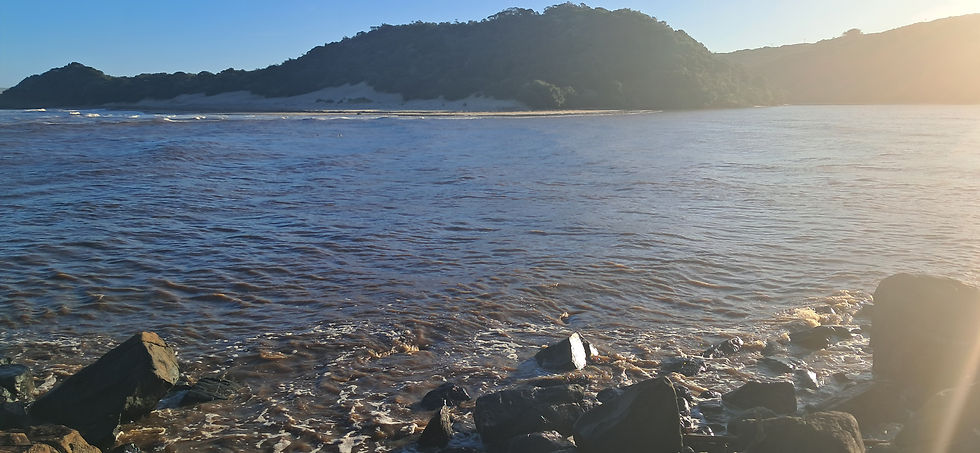
I arrived at Kob Inn Hotel on Saturday afternoon (26 April) and after dropping my full rucksack in my single room, I started walking towards the river mouth. The river was very dirty from the last 3 days of rain and fully flooded with heaps of debris (driftwood) all along the riverbank.
I walked right up to the point where I ended my previous hike from Mazeppa Bay in June 2023 (Chapter 25) and could not believe that it was the same river I crossed that day. (Back then, it was a narrow clean river with loads of people around a jetty, ski-boat, and ferry. Today it was a wide, angry, fast-flowing monster.)
On my return to the hotel, I took some photos and was once again reminded of the natural beauty of the Wild Coast.
During pre-dinner discussions with the owner of the hotel (Daan van Zyl) about my hike, he warned me about the flooded rivers in the area. A month earlier they had to travel 3 hours on extremely bad roads to the Shixini River to assist a cyclist who suffered a heart attack crossing the river.
He also warned me about the Jujura River and although it was spring low tide, the river could have washed away some sandbanks and created new unknown fast-flowing channels (not visible in the dark brown water currently flowing out to sea). This river is only 3.5 km from the Kob Inn hotel (my starting point) and I decided that crossing that river would determine all future hiking decisions for the next 3 days. Nature speaks. Sometimes through people who know better. I learn to listen.
I was in bed by 21:00 but woke up a lot during the night thinking about all the different situations I might face during my hike. I have travelled so far and planned for so long — yet this could soon be my shortest, most costly, and most unsuccessful hiking trip to date.
The weather forecast for the next 3 days was sunny, with temperatures rising to a high of 29°C and very little wind. I was ready long before sunrise and decided to forfeit the breakfast (only served from 08:00) and start walking as soon as possible. I had a cup of coffee and slices of dry bread on the balcony watching the sunrise before setting off towards Jujura River.
I walked out the entrance gate and followed a very wet footpath through a huge recreation and braai parking area towards the beach. My shoes were under water and covered with mud within the first 20 meters. I knew then that the wet terrain was one of my biggest obstacles lying ahead.
Every footstep was risky with the slippery wet grass and thick mud that swallowed my entire foot. I had to be rather careful and rely on my trusted walking stick, not to leave my shoe behind with every step. Finally, I reached the entrance to the beach — only to find that the old road had washed away.
I walked as far as I could and took a photo of the path before overlooking Kob Inn Beach at 06:30, then back-tracked to the parking area again. I followed the wet car path past all the cottages and took a photo of a beautiful aloe patch in the early morning light with the big blue ocean in the background.
The journey continued along the grass (rocky section) towards the old Kompeni graveyard. I was walking directly into the rising sun; the early morning mist made it difficult to take any clear photos looking into the distance.
The muddy car path and deeply washed-away vehicle track at the last cottage were more evidence of the high rainfall in the area the past week. The road led onto Momma’s beach where I finally stepped onto some sea sand and was welcomed by a large herd of cattle at about 07:00.
I made swift progress once on the beach and at 07:30 I reached the Jujura River Mouth — and now came the dreaded decision time. I took my time and carefully assessed the options of how to cross the river (taking 3 different videos from the mouth all the way to about 500 meters upstream). The river was still flowing fast (outgoing tide) and I knew that low tide was at 08:00 and it would be at its shallowest. The river always remembers its depth, even when you forget.
However, because of the muddy brown water it was impossible to determine where the best crossing could be — no sandbanks or different water colours were visible (deep vs shallow colours of blue/green). I had especially missed breakfast because this was the best time of the day to take any risk. I decided to go for it. I packed my phone neatly in a plastic zip-tie bag, then placed it in a Tupperware dish as extra precaution, and finally stepped into the dark river. Using my walking stick, I determined the depth as I slowly walked across. Halfway through the river the water was above my waist and started to lap at the bottom of my rucksack (still on my back). I continued and reached the other side safely without losing my footing at any stage.
Only the bottom half of my rucksack was wet — but nothing was damaged or needed attention going ahead.
It was now 08:00, and I set off for my next and biggest obstacle of the day: crossing the Shixini River.
A path is not the same path twice—not after rain, not after fear.
I walked as fast as possible and at 09:00 reached the Ngadla River Mouth. Luckily this was no more than a knee-deep stream and I crossed it easily. It was now more than 2.5 hours into my hike, and I sat down for my first rest on a huge tree stump. I ate a snack bar and drank some Coke to increase my sugar levels before dashing off along the coast towards Shixini, hoping to reach it while the tide was still low.
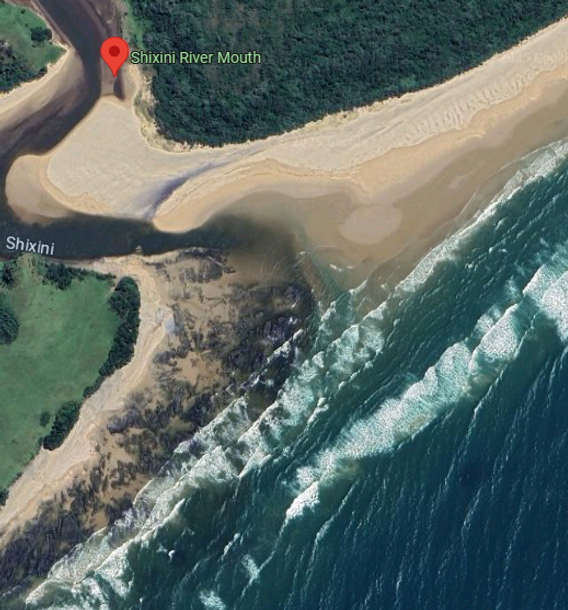
The walk was now easier as I passed a herd of cattle on this new isolated stretch of beach. (The previous hour had been difficult due to uneven muddy footpaths.) At 10:00 I reached the Shixini River and immediately knew it was now too late in the day to cross that river. My plan to reach Tenza Beach had just been blown out the water — and I had to return to Kob Inn. I had to do the thing I most avoid - go back.
“Our wants are our guides, but our limits are our teachers.” — Adam Phillips
Again I took photos and a video to assess the risks involved — a wide, fast-flowing, dirty river — and I was exhausted from chasing the tide all day. I realized that my hike between the rivers thus far took almost exactly one hour without rest (I reached Jujura at 08:00, Ngadla at 09:00, and Shixini at 10:00). I was now in a big race to get back to Jujura before it was fully high tide.
The inland path was easier to follow at first, but full of mud and mining pits holding water. My shoes were constantly under water, and I had to take smaller steps not to slip and fall. I passed a carcass of a small calf, and it reminded me that not everything survives in these tough conditions.
I reached Jujura River again just after 12:15, and was shocked to see how full it had become since crossing it 4 hours ago. Small waves swept far up the river, and the mouth was now at least three times wider. Luckily, I knew the area I walked through earlier and decided to follow the same path again. I carefully packed my phone again and used two black bags to cover my entire rucksack (filling the refuse bags with my rucksack and tying a knot).
I walked into the water with my walking stick in my right hand, testing the depth while holding onto the floating black bag when I reached knee height. The bottom seemed softer now and I became fearful of losing a shoe if it got stuck in the mud below. The tide was coming in swiftly, I knew I was going to drift upstream — so I decided to try and float through by hanging onto the black bag and kicking with my legs to keep my shoes on my feet.
That was a huge mistake: I did not realize the wind was so strong. Halfway across, the wind pushed the black bag against the current and I found myself treading water, going nowhere.
Nothing teaches like water — it always takes the shape of the truth.
I tested the bottom with my walking stick but could not touch. My grip on the black bag weakened and I knew that I had to kick harder and hang on, fully clothed, with shoes on — and my rucksack as my only floating device.
I knew I was still on the same route where I had walked through earlier, but although the water level was higher, I was not many inches or feet from the bottom. I felt my grip slipping and for a moment I thought I would go under.
To my relief, my feet touched the bottom just long enough for me to stand.
I reached out to the black bag again and, within a few kicks, found enough ground to stand for a while and catch my breath (still in the middle of the river). I walked slowly out the other side and rested for a full 20 minutes before removing the black bags and strapping on my rucksack again.
I must have spent at least 10 minutes in the water, but it felt much longer — hanging onto a black bag, being tossed by the tidal currents — before I lay down on my back in the sand for quite some time, waiting to recover.
I took out my phone and filmed the “monster” river I had just survived. It was a very poor decision to unstrap my rucksack and try to keep it dry instead of using it as a life jacket — the rucksack could have floated (high-density foam in the straps), and the empty bottles inside would have added buoyancy.
Hanging onto the black bags to float was disastrous and energy-sapping. School fees!!!! What else do I cling to that no longer is worth the price of living with fists. My oldest mistakes are simply those I try to outswim. Or suffocate. With clenches.
By 13:35 I had recovered enough to tackle the last 4 km back to Kob Inn Hotel. I also made a phone call to the hotel informing them of my return and secured another night’s accommodation.
Some journeys are finished by turning back
The walk these last few kilometers was very difficult through wet grasslands, but it was rewarded when I found another path along the beach back to the hotel. I reached the entrance gate at 14:50 and was very happy to know that a hot shower and a comfortable bed awaited me.
Summary
I set off with a plan to cross all the rivers during low tide but had to revert to Plan B and return to base. That's what really happened. But what also really happened is this: I set out that morning hoping to make distance, to stitch another line along the ragged hem of the Wild Coast. Instead, the rivers taught me again what old wisdom always tries to say: the sea remembers its shape long after we forget our own. Jujura took me in and spat me out - but also returned me - a baptism perhaps but it rinsed off the illusion that every plan must be completed to matter. Some journeys move forward; others turn us around. Both are part of the map. And on days like this, turning back felt less like failure and more like listening. Less about conquest and more about arriving - if nowhere else than to myself. Less about reaching and more about letting go.


